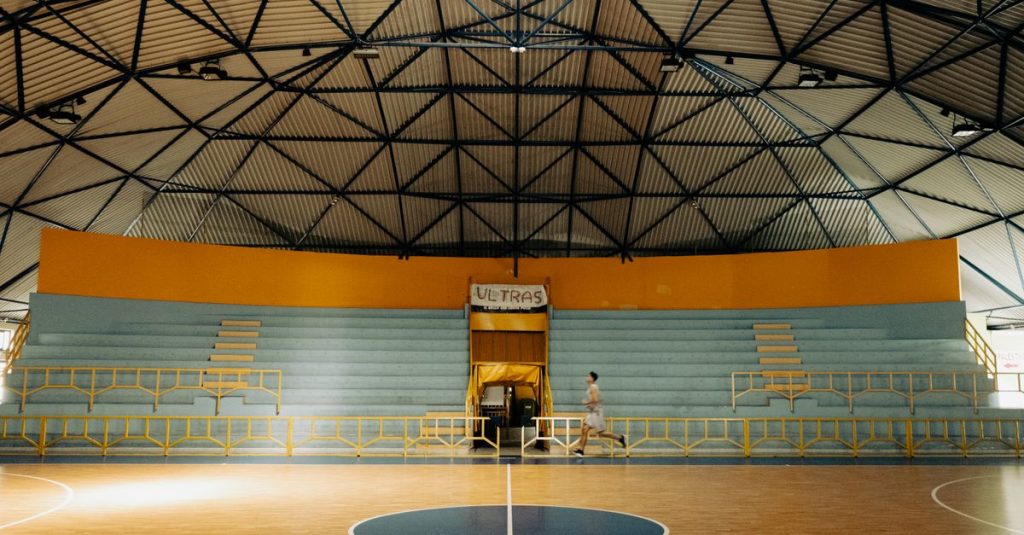
Stephen Curry’s right knee began to trouble him during an off-day workout in an empty downtown Minneapolis arena in late January, and the problem went on to derail his 17th season. The Golden State Warriors finished 37-45 and missed the playoffs, and Curry is now sidelined again, this time with an oblique injury.
Four days before that workout, Curry had been named an All-Star starter for an 11th time. He was averaging 27.2 points on extreme efficiency and keeping the Warriors at a respectable 25-21. His co-star, Jimmy Butler, had torn his right ACL the week before, and Curry, at 37, was again carrying overloaded schemes and a heavier offensive burden. His knee started barking.
“That was the moment where I started to get concerned,” Curry said. “It just didn’t feel right.”
Curry tried to play through what he described as “a weird soreness and pain that didn’t go away.” Although he was initially listed as questionable, he scored 26 points against the Timberwolves, rested for a game, then added 27 in Utah to close the road trip and 23 against the Detroit Pistons once the team returned home. The pain and concern did not subside.
“Against Detroit, it took everything in me down there on the training table just to be like, ‘Oh, I can go out here tonight and play,'” Curry said. “And I was just faking it for the first whatever [25 minutes].”
His final sequence before he left that game carried a certain poignancy. Curry came off a third-quarter pindown into an isolation against Ausar Thompson and did what he described as “a high-step thing because it hurt so bad in that moment.” He then shook Thompson with a crossover combination, hobbled into the lane and poured in an and-1 floater over one of the best perimeter defenders in the world. That gave him 23 points in those 25 minutes. He then limped to the sideline and told Rick Celebrini, the franchise’s lead medical decision-maker whom Curry trusts implicitly, that the swelling and stiffness had become too much to bear.
“I got smart about the situation,” said Curry, who missed the next 27 games. “We had to go get scans.”
Balancing brilliance and breakdown
Curry embodies a stark contrast in the twilight of his Hall of Fame career. On the court, he can still string together what coach Steve Kerr calls “magical” performances. Away from the spectacle, however, he is in a constant race against time, continually refining his body-maintenance plan so that he can be available as often as possible.
The scans on his right knee after the Detroit game, on Jan. 30, revealed no structural damage. Celebrini prescribed rest, and the team officially labelled the condition patellofemoral pain syndrome, commonly known as “runner’s knee”, an overuse issue. Curry initially believed he would miss a week. He still hoped to compete in the 2026 All-Star game in Los Angeles two weeks later, and he planned to recruit former teammate Klay Thompson for the 3-point contest. That hope faded as the problem persisted.
While in Los Angeles, Curry tested his progress in a workout. He intended to play the first game after the All-Star break against the Boston Celtics, but after a few higher-intensity moves, he abandoned that plan.
“Sabrina [Ionescu] was actually rebounding for me,” Curry said. “I tried to go harder, and there were certain directions of movement and stuff that just didn’t work.”
The absence spanned 27 games over 65 days. Curry’s lowest point came on consecutive days in late March. The first came in Atlanta. The morning after the Warriors lost to the Hawks, which dropped them to 33-38, he was due to scrimmage to test his knee. The Warriors even announced it, but it never happened.
“That was the true setback,” Curry said, shaking his head. “I couldn’t even get to the point where I could play. Even just getting spot shots, it felt worse than it had before.”
The next night, the Warriors won in overtime against the Dallas Mavericks. That uplifting result was overshadowed when fourth-year wing Moses Moody ruptured his patellar tendon on a dunk attempt about 25 feet from Curry on the team’s bench. Moody needed a stretcher to leave the court.
“I saw him go down, Jimmy [Butler] go down [in January]. You look at the calendar,” Curry said. “Then, you start thinking about more of the existential part of it. Will I have to deal with this the rest of my career? Is it something that will … what’s the word … will it diminish what I’m able to do on the court?”
The trickiest aspect, Curry revealed, was a bone bruise in his knee caused by “deteriorated” cartilage that put pressure on the wrong parts of the joint. Limited blood flow to the area slowed the healing.
“It was basically holding,” Curry said. “It wasn’t going either direction.”
Curry eventually felt enough of a breakthrough to return for six games between April 5 and April 17. He scored 35 points in the team’s memorable throwback win over the LA Clippers in the play-in tournament. Even so, he cautioned that the knee trouble had created a “new normal” for him. His prolonged hug with Kerr and Draymond Green on the night the Warriors were eliminated in Phoenix also served as a reminder of how close the group is to the finish line, and it fuelled doubts about Kerr’s future.
Adapting for the long haul
Curry’s performance to end the season gave him a mental boost heading into an offseason of work that he knew had to be tailored differently from those of the past.
“Throttle the general intensity back,” Curry said. “The idea, the theme from Rick was every workout that I did this summer, I should feel like I left a little bit on the table as opposed to just exhausting [everything].”
This is a difficult concept for Curry. He built himself into the world’s greatest shooter and prolonged his career into his late 30s through excessive overwork, sharpening his jumper, bulking up his body and maintaining his condition relentlessly. At 38, the medical staff finally told him to calm down.
“He’s staying off his feet [more often],” Kerr said. “Relying on the fact that he’s built up this incredible skill level that’s not going to leave him. Then, he’s found a way to stay really fit without pounding the knees, the ankles. He’s on the bike, underwater treadmill. He’s creative.”
Curry has joked that golf was the best summer prescription, though he insisted there is some truth to it. He replaced a few strenuous days on the court with leisurely days on the course.
“There’s an element of active recovery,” Curry said. “Walking golf courses loosens [the knee] up to a degree. It keeps your body going without putting too much demand on it.”
From a basketball perspective, Curry did not feel his body was as prepared as usual for training camp and the preseason. Celebrini kept him out of practice more regularly in October. In the season’s second game, he missed 10 of his 15 shots and struggled down the stretch as the Warriors gave up a 12-point lead to the Memphis Grizzlies.
“He probably wasn’t quite physically ready yet to close that Memphis game,” Kerr said. “But the long-term benefits are less wear and tear. So, we’re good with that. The league has never been faster, more athletic, players sprinting around, the ground covered.
“Compared to Steve Nash or John Stockton, other guards of his ilk who were still playing at 38, 39, 40, the game’s a lot harder now.”
In his prime, Curry ranked among the league leaders in distance travelled per game. Tracking data had him covering between 2.3 and 2.6 miles on average in his early 30s. That figure has since fallen. The Warriors are trimming his minutes to around 28 per game, have not cleared him to play both ends of back-to-back sets, and have introduced philosophical offensive tweaks this summer that ease his burden. Through 10 games, tracking data has him travelling 1.9 miles on average.
“He’s more stationary more often,” Kerr said. “Fewer of the movement sets we’ve run over the years where he’s coming off a triple screen and running from the strong side to the weak side and back.”
Curry admitted that reduced minutes and rest nights test his “discipline”, but he has come to appreciate the cumulative results. He said he can feel the difference after a week of 28-minute nights as opposed to 32 minutes.
“If we want to be any semblance of a threat come the end of the year, I need to be available,” Curry said.
After shaking off the rust, Curry put up these point totals in a seven-game surge that powered the Warriors to an eight-game win streak: 24, 44, 31, 34, 29, 41 and 25, scoring better than a point per minute.
But how often does he believe he can be that version of himself?
“I would hope every other night,” Curry said. “At least come March, April, May.”
Contract, legacy and a fragile roster
Curry faced a contract decision before the season. The Warriors presented him with a menu of extension options, which basically came down to a max deal, a pay cut or a wait-and-see approach. The last would have given the Warriors the most long-term flexibility.
He chose the slight pay cut, signing a two-year, $116 million extension. That gives $10 million in cap space back to the Warriors next summer, while he receives a player option on the final season. Curry said the decision was about clarity for everyone involved, eliminating distractions and still earning his financial worth, while giving a franchise he intends to stay with through his 20th, and possibly final, season an extra boost of flexibility.
“All of it,” Curry said. “I assumed that it would probably be one of, if not the last, contract I signed. I’m not afraid to say it. But maybe I’ll surprise myself and want to keep going.”
If circumstances demanded it, Curry said he would have been content to slide into a more complementary role late in his career, as most fading stars eventually do. Perhaps he still will.
“It would not kill my ego,” Curry said. “I want to win. Whatever that means, you make decisions based on what’s in front of you.”
He still has All-NBA talent, and his impact is too immense to be relegated. The Warriors remain built around his powers. The roster, however, is fragile and wounded. Butler and Moody are still rehabbing serious knee injuries and are not expected back until midseason. Projected starting centre Kristaps Porzingis has stepped away from the sport, and his contract has yet to be moved in a trade. Curry is out. That leaves $151.9 million in salary sidelined indefinitely and only $67.8 million in salaried players left to keep the Warriors afloat while their stars recover.
“The team’s got to help him,” Kerr said. “If we can handle the games and the margins and win some games he doesn’t play, put ourselves in a good spot. I think we’re going to do that. I love the attitude of this team. I love the energy, the spirit. I like our talent.”
Butler and Curry will eventually return. Brandin Podziemski has shown notable improvement in his fourth season, and the front office appears to have hit on some useful minimum signings. The arrival of Yaxel Lendeborg has also injected life into the franchise, generating belief that the Warriors have a rookie who can contribute immediately and eventually evolve into the kind of mid-prime wing who can lead a team after Curry is gone.
“I don’t care about 1A, 1B, 2A [pecking order],” Kerr said. “None of that matters if you’re not taking care of your business. We need to win in the margins [now], then [later], you can start talking about Jimmy and Yaxel and Steph and all three of them with the ability to close a game. Now, we got something. Now, we can compete with anybody. But at this stage, we’re the furthest from there.”
Without Curry, the team is in a temporary survival mode. One month into his career, Lendeborg is being asked to accelerate his development, take on a lead creation role he did not even have in college, and help lift the Warriors to enough wins until the headliners return.
“Probably like 6 out of 10,” Lendeborg said when asked about his confidence level. “It’ll be fun trying to figure out what ways I can score best, what to do to be able to be an efficient scorer. Then, the other four is like, man, am I going to be able to live up to it? Am I going to be able to help out the team the way I want to? Time will tell.”
Curry made clear that there has not been, and will not be, a retirement decision soon. He is not afraid to acknowledge the approaching end, however. He watched his father, Dell, and many of Dell’s teammates reach that final stage, when the body starts to fade and the clock starts to tick.
“I want to appreciate what’s happening right now because I don’t want to just go through the motions,” Curry said. “Then, it passes you by.”